


Last updated: September 2026
Electric vehicles are an important part of modern transportation technology, and most EV owners charge at home. A professionally installed home EV charging station provides convenient overnight charging and helps ensure your electric vehicle is ready when you need it. Here is what Toronto homeowners should know about EV charging station installation, charger levels, electrical requirements, and the installation process.

Access to a reliable charging station helps ensure that your electric vehicle can meet your daily transportation needs without sacrificing convenience. An efficient home electric vehicle charging station keeps your vehicle charged and ready while allowing you to schedule charging during lower-cost overnight periods when available. The cost of running an electric car depends on the vehicle, distance driven, electricity rate plan, and charging schedule.
Electric vehicle charging stations are generally divided into three levels: Level 1, Level 2, and Level 3 or DC fast charging. Level 1 and Level 2 EV charging stations are commonly used for home charging, while DC fast charging stations are primarily installed at public and commercial locations.
A Level 2 charging station charges a fully electric vehicle considerably faster than a standard Level 1 outlet. Actual charging time varies depending on the electric vehicle, battery size, remaining charge, temperature, and EV charger output.
Electric Vehicle Charging Stations: Which Chargers Can We Install?
Modern EV charging stations can be installed for a wide range of fully electric and plug-in hybrid vehicles. Ontime Electric installs residential Level 2 EV charging stations from Tesla, FLO, ChargePoint, Grizzl-E, Emporia, and other charger manufacturers with models approved for use in Canada.
The right EV charging station depends on your electric vehicle, available electrical capacity, charging output, connector compatibility, cable length, and features such as scheduling, Wi-Fi monitoring, and load sharing. Our electricians can recommend a suitable home EV charging station during the quote process.

EV Charger Rebates and Incentives in Ontario

Ontario currently offers no general provincial rebate for individual home EV charger installation. The former Ontario Electric Car Rebate Program ended in 2018. Other programs may support eligible public, workplace, multi-unit residential, community, or fleet charging projects. Incentives can change, so confirm current eligibility before including an EV charging station rebate in your installation budget.
Will Your Electrical Panel Handle a Level 2 EV Charging Station?
Many residential Level 2 EV charging stations are configured between 32 and 48 amps. The exact output depends on the charger, electric vehicle, and available electrical capacity. Before EV charging station installation, a licensed residential electrician must assess the electrical system. This determines whether the panel can safely support the additional load.
A 200-amp electrical service may have sufficient capacity, but this must still be confirmed through an electrical load calculation. Some homes with 100-amp service can support a lower-output home EV charging station or an EV energy-management system. Others may require an electrical panel upgrade. Available electrical capacity is one of the main factors affecting home EV charger installation cost.
EV Charger Installation in Toronto Condos
Installing an EV charger in a condo is different from a house: the charger usually connects to the building’s electrical infrastructure, and you need to submit an application to your condo board first. In Ontario, condo owners have a legal path to request an EV charger installation under the Condominium Act, and many Toronto buildings now have a process for it. A typical condo project involves a load assessment of the building’s capacity, board approval, a method for tracking and billing your charging use, and an ESA-notified and accepted installation at your parking spot.
Ontime Electric handles the technical assessment, the electrical drawings your board may ask for, and the installation itself. If you’re starting the conversation with your condo board, call 416-882-6000 — we can provide the documentation they may require.
Tesla Wall Connector Installation
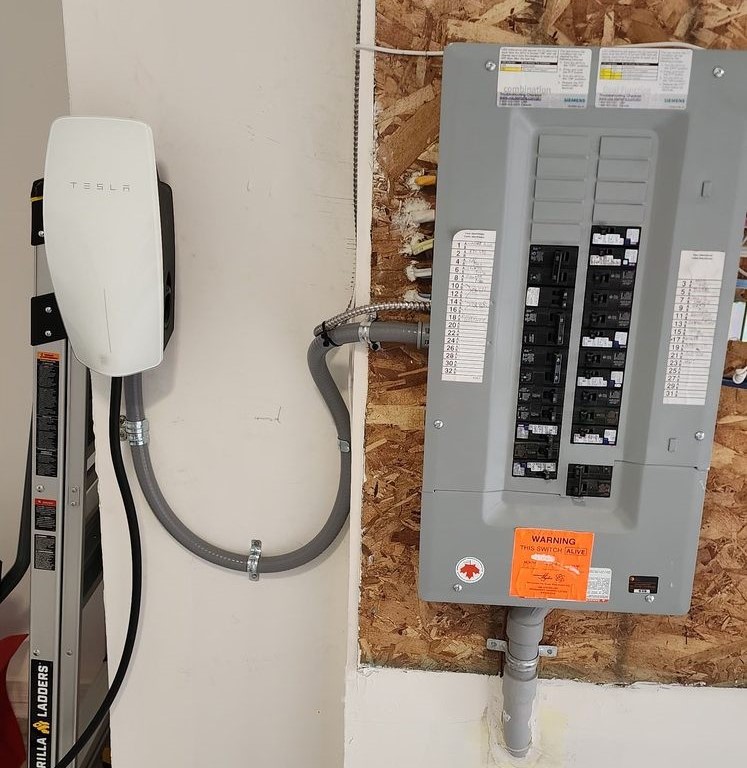
The Tesla Wall Connector is one of the most requested chargers we install. It requires a dedicated 240V circuit, and the right breaker size depends on your panel’s spare capacity — a load calculation tells us whether you can run it at full 48-amp output or should configure it lower.
Ontime Electric supplies the wiring, dedicated circuit, and ESA-notified and accepted installation for Tesla Wall Connectors (Gen 3) and J1772 chargers alike, in garages, carports, and driveways.

Hire a Professional for EV Charging Station Installation
Ontime Electric provides professional residential EV charging station installation in Toronto and the GTA. As a licensed electrical contractor, we handle the load calculation, required ESA Notification of Work, charger setup, and testing. Upfront pricing is provided before work begins.
Our licensed electrician in Toronto installs each EV charging station safely, efficiently, and in compliance with the Ontario Electrical Safety Code. Learn more about our residential EV charger installation, call 416-882-6000, or email info@ontime-electric.ca.

EV Charger Not Working? Common Causes
If your home EV charger stops working, check these steps first:
Ontime Electric repairs and troubleshoots existing EV charger installations across Toronto, including units installed by other companies.